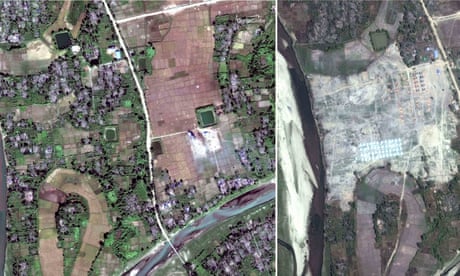
Source maungzarni, 19 March
Berlin Conference on Genocide 26 February 2018
A State Myth of "National Race" and the Tatmadaw's War on the Rohingya and other
Myanmar Ethnic Groups"
Michael W. Charney
(SOAS, the University of London)
Introduction
The Rohingya Genocide is as confusing as it is complex.
There is a fog that obscures what is happening on the ground in historical perspective because just so much is happening in real time.
Parties which seek to prevent another great human tragedy have little time to scamper around for the data and the situation gets viewed almost knee jerk from whichever side one is in, in debates concerning human rights issues and national sovereignty issues, whether one is concerned with development or political rights, or on the side religious freedom or religious hatred.
It is no surprise that Islamophobes in the West and Bamar ethno - nationalists have found common cause with each other. .
And the Myanmar state, both the civil government and the Tatmadaw, have actively taken advantage of this confusion to accomplish two things, and, as I speak here in Berlin in a museum dedicated to the Holocaust...
I point out that the Nazis fought both a war on the Jews AND used the war on the Jews to fight a war on German liberalism.
I would similarly argue that it is CRUCIAL to unders tand that as with the Holocaust, the Myanmar state is fighting a war against the Rohingya as it is again beginning to do with other ethnic groups as outsiders, on the one hand, but also a war on emerging Myanmar liberalism on the other.
What is happening right now is about the Rohingya, but not only about the Rohingya. The state and the army have very adeptly blinded the Bamar population and many of the ethnic minorities to the eradication of liberalism within the country with the willing support of ASSK and her NLD party.
There are many other scholars here better versed in genocide studies than I, what I intend to talkabout instead is how states in Myanmar have actively using scholars and history both in the past and today to obscure the truth and suppor t state programme s that have worked against the Rohingya.
I. A Buddhicized Past
In the fifteenth century, the Kingdoms of Ava and Pegu tried to establish cultural hegemony over the Indo-Aryan kingdom of Rakhine, importing kings and queens, courtiers,Buddhist monks, and Burmese -speaking settlers.
The Rakhine ruler who ousted these foreign invaders, established a religiously hybrid court, a sultanate, but in addition to permitting Buddhist immigration and European migrants from abroad,also raided Ben gal and brought to Rakhine thousands of Bengali Muslim every year.
Many of these were planted in the Kaladan River areas close to the concentrations of Muslims in Rakhine today where they grew rice and still grow rice until the recent crisis.
We do not find a lot of pre- 18th century tensions between the Buddhist and Muslim populations.
The physical geography and climate favored approaches to living and ruling, interacting, and community building, social mentalities that were flexible and inclusive, that favored the emergence of ethnically and religiously diverse communities.
But this diversity was soon obscured by an Invasion from the Irrawaddy Valley.
When it conquered Rakhine in 1784, the Myanmar court tried to produce histories that made Rakhine h istorically a part of greater Myanmar.
Myanmar Buddhism was introduced, court literature and local Buddha mages were brought back to the Irrawaddy Valley and so too were tens of thousands of Muslims, Hindus, and Buddhists.
Rakhine Buddhists and Muslims both fled to British Bengal, the Buddhists settling in the area that became a big refugee camp, which became known as Cox's Bazaar.
Absent court literature, Buddhist monks from Rakhine rewrote from memory and produced new chronicles in opposition to Myanmar rule, but in doing so created a Rakhine history only from their particular point of view, not purposely leaving the Rohingya voice out, but not including it either.
This might have been balanced out with Rohingya voices if not for another accident of history, the replacement of Myanmar rule with British rule in 1824.
II. A British Colonial Past
The British believed that communities having one native language, one native race, and one native religion.
Despite or rather because of its huge diversity, the British decided that they would split Rakhine in two — the northern half which had a heavier concentration of Muslim and Bengali -speakers would be administered by Bengal and eventually become part of Bangladesh after independence and the southern part, closer to the An pass and the heavier concentration of Buddhists and Burmese - speakers would be (re) joined to Myanmar.
Phayre produced the first histories of Rakhine and Myanmar during the 1830s and 1840s and used sources for the region's history exclusively from Rakhine Buddhist informants and their summaries of Rakhine Buddhist histories.
Phayre was thus innocently or purposefully blinded to the fact that Rakhine had been at least since the 15th century a Muslim and a Buddhist land, with a Muslim and a Buddhist court, and that historically, Burmese -speaking Theravada Buddhists from the Irrawaddy Valley were migrating into Rakhine at the same time as Muslim, Bengali -speakers.
In his writings, Rakhine became an essentially a Theravada Buddhist, Burmese -speaking land.
Later, in1862, when Rakhine became part of British Burma (and later the Union of Myanmar upon independence), it declined into an impoverished neglected periphery of an Irrawaddy based state, its population impoverished where it had once been wealthy, and Muslims and Buddhists began to compete for pieces of an ever shrinking economic pie.
During this period, Rakhine and the Rohingya with it became absorbed into a new myth, created by Bamar nationalists in response to colonial rule, but also informed by Phayre's ethno-racial histories, the Myth of 1824.
In general, the myth held that British altered the system against the Bamar Buddhists, who were the indigenous population, located since time immemorial within the boundaries of the Myanmar kingdom and the modern Myanmar state.
The myth of 1824 was that the British introduced colonial rule into Rakhine and removed the obstacles to foreigners coming into the country and invited in thousands of Bengali Muslims who the British believed were better workers than the indigenous Buddhists.
This created the first major Muslim populations in the region, led to Muslims overrunning northern Rakhine, forcing the indigenous Buddhists out.
By extension, as each part of Myanmar was acquired by the British, Indian immigration continued with legal controls.
The foreigner Indians, including the Muslim Bengalis, and the foreigner Chinese remained loyal to their homelands, retained their foreign cultures and religions, and sent their money when they could back home.
III.Rohingya and Independent Myanmar to 1962
The Myth of 1824 did not get voiced a great deal in the 1950s.
Under the semi -liberal rule by U Nu and the AFPFL, the emphasis was on national solidarity through ethnic union, not Bamar ethnic chauvinism or racialism.
Because the Rohingya had stood up against separatist Muslims from Bengal, they were praised as a national group in the mid - 1950s by a grateful U Nu.
But this feeling shifted in 1962 with the takeover by a poorly - educated military group led by Ne Win.
This military introduced into state policy the idea of Taingyintha, the 135 national races (Cheeseman).
The Myanmar military ethos is geared around the idea that Myanmar is not just of the Bamars, but of the Bamars and an assortment of ethnic minorities who pay tribute to the Myanmar ruler.
When that hierarchy is not maintained politically, it was the military that restored it, maintained it, ensured it.
Without this hierarchy there is no order and the Bamars are faced with annihilation.
This concept picked up speed in the post -independence period in particular from its prominence in Revolutionary Council thinking from 1964 and was pushed into school texts and other government publications from 1990.
The Taingyintha idea became the foundation for the 1982 Citizenship laws.
According to the 1982 citizenship laws of three categories of citizenship, the first, regular citizenship, was only open to those who from the military's perspective was a member of an indigenous ethnic group (instead of ethnic group, they term this race) or not and these identifications were made according to the traditional hierarchical ethnic imaginary of the Myanmar kingdom.
Key to the Taingyintha idea was that any group that was not indigenous and was foreign was a threat to national solidarity.
At a time when the country was facing armed insurgencies throughout half the country by "native race" ethnic minorities, Indians and Chinese had to be suppressed and forced to indigenize or leave.
Conveniently, there was no authoritative list of what these 135 Taingyintha specifically were, it was usually used as a legitimizing phrase to explain why one or another group, the Chinese or Indians, were not included.
In combination, the Myth of 1824 and the Citizenship laws of 1982 have had a disproportionate impact on the Rohingya.
The Myth of 1824 portrayed the Rohingyas as non -indigenous and as Indians.
And the 1982 Citizenship laws established three different categories of citizenship— if you were a member of one of the national races you were a citizen even if you did not have papers, if you werenot, you had to have papers showing that you had been in Myanmar in 1948.
This made only the Rohingya and other officially non -nationals peculiarly vulnerable to registration abuse.
In 1978, in the run-up to the enactment of the 1982 law military operations, the Nagamin operations, were run at the border to sweep out undocumented aliens.
This caused the first major exodus of the Rohingya out of the country, a quarter of a million and many who had documentation saw these replaced with a new card.
When the military replaced the BSPP government in 1988, it required a change of documentation again, in which government officers denied registration to many Rohingya.
In any case, the junta at the time reified a line of thinking about Rakhine that could be traced back in one way or another to Phayre's work in the 1830s.
Buddhist Rakhine were Rakhine, but Muslim Rakhine, the Rohingya were not.
The idea that the Rohingya are not part of the 135 national races, like others, is very significant because it makes the Rohingya part of the legacies of British colonialism and omething that can and should be dealt with as part of the last steps of achieving complete independence.
It is the reason Myanmar authorities would not permit Rohingya children to attend schools of any kind, except for madrasas, so they could learn the Koran and nothing else.
It is why the Bangladeshi government has had to provide basic training in different skills to Rohingya refugees because so many are functionally illiterate and lack skills of any kind to use to support themselves economically.
But it is the act of trying to correct these poorly founded claims, claiming Rohingya to be a national race, that makes Buddhist Rakhine and others upset.
The underlying tension then that has caused the explosion is a very old one, two hundred years in the making because of colonial -era orientalist misunderstandings of the region's history.
British colonial administration and scholarship encouraged not just Rakhine Buddhist hostility to Muslims during the colonial period.
The Rohingya are just as much a Taingyintha as anyone else or or are not just as much as no one else is.
Conclusion
In conclusion, I wish to draw your attention to the fact that how we understand Rakhine, the Rohingya, and Myanmar ethnicities today is the result of numerous phases of successive states and non -state actors responding to policies of those states shaping the historical record for political purpose.
The Rohingya have been negatively and peculiarly impacted by these efforts because of historical accidents that placed them on the wrong side of the border.
The Rohingya did not cross the border, the border crossed them.
With military rule the Myanmar state has increasingly tried to integrate Burmese - speaking Buddhists in Rakhine with the national Bamar ethnic group.
In fact, one way to view the problems we see now in northern Rakhine is that these anti -Rohingya pogroms are the last thrusts of full, lowland state integration — the Myanmar military is literally pushing Bamar civilization up the hills (Scott) .
The Myanmar state is now fully integrating its frontier, non - state spaces into the body politic and with it the national language, the national faith, and the national culture.
Pushing out the Rohingya who they see as not belonging.
But what happened in the historiography of the Rohingyas was also reinforced by the impact of area studies on the scholars who studied Myanmar.
With independence from 194 8, Myanmar was a country not a colony and everyone domestically and abroad who studied Rakhine and the religious problems there was trained to view Rakhine as an eternally Theravada Buddhist land.
This is why you will find a number of scholars who adamantly deny the existence of the Rohingya in the historical past — they have been trained to only read the country by a Bamar Buddhist register.
But this a historical legacy has caused them to introduce a new era of untruths, writing histories that try to erase the Rohingya and their history as merely being incorrect data rather than as people with a historical narrative that challenges their own.
This a historical legacy has also led colonial -era and Rakhine and Bamar archaeologists since to reconstruct religious buildings in ways that obscured a Muslim presence, to rely upon only Rakhine Buddhist texts as the only acceptable historical sources, and to consider references to Rakhine as a Muslim society or some eclectic mixture of different religious groups as a misunderstanding by European traders.
Rather than kicking out in a sense the Rakhine Buddhists from this region, I am merely inviting the Rohingya back into their own history, which they shared in an intimate way with the Rakhine Buddhists, before the divisions that were introduced by a series of states that were interested in how best to control power rather than reflect in a fair way, the peoples who had historically been part of Myanmar.