Sunday, 21 April 2019

Call for Mandated Concrete Actions To End Rohingya Crisis

by Admin, 14 April

The crisis of Rohingya is as a point of fact for life and death of a million of those Rohingya refugees taking shelter in Bangladesh and the remaining Rohingyas and Kamans numbering between 350,000 and 500,000 including about 150,000 who have been systematically trapped in ghetto types of camps across Arakan (Rakhine) state and still facing frequent attacks, deadly starvation from June 2012.

The solution to this crisis is yet to be paved and directed with mandated concrete actions, regardless of various attempts of exploitation by China and military powered criminal government of Burma (Myanmar).

We acknowledge the difficulties faced by the government of Bangladesh and our gratitude ever with the people and government of Bangladesh.  Since the case of  Rohingya refugees are being a heavy burden for Bangladesh for years, the country has full right to act on behalf of them and deliver justice in the bast manner. However, failure of finding solution or action should not be the fact to compel the Rohingya refugees for repatriation without dignity. Beside certain safety concerns, the current program of relocation of just a small number of Rohingyas into 'BaShanShar'and/or  current suggestion of  possible just a banner of safe zone  in similar situation, are not part of solution either when the core solution rely within Burma.

The military powered Suu Kyi government has been repeatedly boasting about signing of Repatriation Deal, MoU, and misclaiming of  her government has materialized the 86 of 88 recommandation of Annan Commission and collecting huge amount of foreign funds in the name of stabilization in Arakan state. In deed, her government has taken no progress at all to cease ongoing attacks on the ground, nor safe return of Rohingya refugees with guarantee of relocation at origin villages, citizenship rights and lifting all forms of restrictions and oppressions.  

The matters also relate to question that- for how long and who will look after continuously for a million of these Rohingya people if we keep the crisis alive?


As you aware, the case of achieving of justice in Myanmar is not just for the past but also for future  since the rejection of Rohingya been a common cause jointly by monks, nationalists and majority public. The neutralization of the criminal government authorities from top to bottom could only happen by prosecution of all of those responsible and/or address the root causes to end the cycle of violences and attacks against Rohingya and other minorities. We are still witnessing the ongoing  vigilante attacks, blockages and segregation against Rohingya and other muslims across Arakan state and central Burma . 


It is therefore the ending of ongoing genocide of Rohingya in Burma and all form of violences and relocation of these a million of vulnerable Rohingya refugees with dignity and safety, will never happen unless mandated concrete actions taken by international communities throughout a global political commitment of R2P resolution and humanitarian intervention and creation of a protected safe zone, and are also in fact only viable options since' security, safety, existence and welfare' have been fallen into heavily risk and national authorities manifestly reluctant to protect, as well as the state has been sponsoring genocide, war crimes, ethnic cleansing and crimes against humanity.


M. ILYAS (chairman),  h/p: +(44) 7780 359718, UK

contact in other countries

Habib, h/p: +(61) 413 799 418, Australia

HF. Hashim Mahmood, h/p: +(88) 1729 872581, Bangladesh

Ayub Khan, h/p: +(60) 11 33315246, Malaysia

Friday, 1 March 2019

PRE-RECORDED SPECIAL ADDRESS BY UN SPECIAL RAPPORTEUR ON HUMAN RIGHTS SITUATION PROF. YANGHEE LEE TO THE INTERNATIONAL BURMA CONFERENCE ON PROTECTION AND ACCOUNTABILITY, BARNARD COLLEGE, NEW YORK, 8-9 FEB 2019

Source Freerohingyacoalition, 


Human Rights in Myanmar - videotape presentation by Prof. Yanghee Lee


Ladies and Gentlemen,

It is a great honor to present at this first ever International Conference on Protection and Accountability in Burma.

As you may know, I have just completed an 11 day visit to Thailand and Bangladesh. Today's presentation will be based on my visit and the End of Mission Statement presented on 25 January 2019 in Dhaka, Bangladesh.

It is quite unfortunate that the human rights situation in Myanmar continues to deteriorate and how many parts of the repressive architecture that existed under successive military governments remain. Instead of bringing about the democratic reforms that were promised, the civilian government is consolidating what military governments worked towards for many years.

Today, I will address the overall situation relating to democratic space; human rights abuses and violations in the ethnic states, and the situation of Rakhine.

Democratic space, including the freedoms of speech and association, is ever fragile. Communities across the country remain divided along religious and ethnic lines, and members of minorities face marginalization and discrimination. Ethnic nationalities around the country continue to be subject to domination by the central government and the military, despite the official stance that they are working towards peace.

It is evident that under the 2008 Constitution, Myanmar cannot be called a democracy, and until the constitution is reformed, the transition to democracy will not be achieved. I am greatly concerned that the enduring repressive environment is discouraging people from speaking out freely about human rights violations and injustices. Journalists and human rights defenders continue to be targeted for exercising their right to freedom of expression: Zau Jat, Nang Pu and Lum Zawng, the Kachin peace activists, and Wa Lone and Kyaw Soe Oo, the two Reuters journalists, languish in jail for their work. Journalist Swe Win has been subjected to judicial harassment for his criticism of the Buddhist extremist group, Ma Ba Tha.

During 2018, there was recurrence of fighting in Kayin State despite the Karen National Liberation Army being a signatory to the Nationwide Ceasefire Agreement. This trend has continued into this year, with several clashes already taking place in Mutraw District in close proximity to civilians, who see troops moving through their villages and forests, and hear gunfire nearby. I have been told that the military is constructing new bases in Kayah State, and am concerned that fighting may soon break out there too. There are around 162,000 IDPs in the Southeast States and Regions, living in camps or scattered throughout rural communities.

A unilateral ceasefire of 4 months in Kachin and Shan was announced by the Tatmadaw in December. However, fighting between ethnic armed organizations in Shan have occurred since this announcement.

The government plans to close IDP camps in Kachin, Shan, and Rakhine states, with the possibility of relocating people to remote areas, far from their places of origin and removed from economic opportunities and humanitarian support. The government has failed to consult the IDPs and national and international organizations who are working with the displaced populations. Returns to the IDPs' places of origin are needed but such plans must be in accord with the international standards of safety, voluntariness, dignity and sustainability.

The recent amendments to the 2012 Vacant, Fallow and Virgin Lands Management Law are  worrying. This law will also permit the government to appropriate land from people who live there on the basis of customary practices. This is commonplace in ethnic areas, including Rakhine, Kachin, Shan and Kayin State where communities have depended on this land for their livelihoods, traditions and culture for generations.

Vast areas of land have already been seized from people to make way for hydro-power dams and I have spoken with many who fear losing their lands and livelihoods should planned dams such as Myitsone, Upper Kengtawn, Upper Yeywa and Hatgyi go ahead. There is no transparency surrounding these plans and the government has failed to consult those affected, causing further concern and uncertainty for millions.

In Rakhine State, recent clashes between the Tatmadaw and the Arakan Army reportedly resulted in the deaths of members of security forces and civilians, and which has displaced some 6,000 civilians. The order by the State Government to refuse access to humanitarian organisations with the exception of the ICRC and WFP is entirely unacceptable and a violation of Myanmar's international humanitarian law obligation to allow humanitarian aid. Government rhetoric characterizing the Rakhine community as sympathisers, collaborators and associates of the AA threatens only to increase tensions in the region and divisions between ethnic communities. Similarly, comments by the government linking AA with ARSA are deeply irresponsible, and point to the disturbing prospect of further attacks on the Rohingya population that remain in Rakhine State

During my visit, I received videos of houses burning in Maungdaw township, the second such incident to occur in Maungdaw in 2019 alone. According to information gathered by my team, the houses were burned by Myanmar security forces working in concert with Rakhine extremists. The campaign of violence against the Rohingya continues, with the security forces slowly bleeding the remaining Rohingya population and continuing to force them to flee to Bangladesh.

On Saturday, 26 Jan, a military raided an entire vollage and looted gold, jewelry from the villagers of Tha Mee Hla village in Rathedaung Township in northern Rakhine State. Apparently, only 10 homes in the village were spared of bullets out of a total 84 homes. A seven-year old child had been wounded by an artillery explosion near his home and has been transferred to  to Yangon for treatment.

A couple more developments that warrant mentioning are the repatriation of Rohingyas from other countries. The Rohingya issue has definitely gone beyond the borders of Rakhine, into the region, and globally. Recent developments highlight the internationalization of the Rohingya issue. Saudi Arabia recently deported 13 Rohingya to Bangladesh, where they have been arrested and charged with forging the passports that they used to travel to Saudi. Bangladesh authorities must remember that this group also fled persecution in Myanmar.

Another development is that Rohingya are now arriving in Bangladesh from India, following the deportation of two groups of Rohingya by the Indian authorities to Myanmar. 1,300 people are reported to have already arrived in Bangladesh from India stating that they fled due to fears of refoulement and heightened anti-Rohingya rhetoric from the Indian authorities.

The causes of the current Rohingya situation lie in Myanmar and it is Myanmar that need to find the solution. Its campaign of violence against ethnic minorities, including the Rohingya, the Kayin, the Kachin and the Shan, must end. There must be accountability for the campaign of ethnic cleansing and possible genocide against the Rohingya, as well as the war crimes against humanity perpetrated against ethnic minorities around the country.

Posted in In the News

Post 

Sunday, 27 January 2019

Prosecute Myanmar army chief for Rohingya 'genocide': UN envoy

Source Aljazeera

UN rights envoy Yanghee Lee says holding perpetrators to account for crimes is necessary before refugees could return.

25 Jan 2019 an hour agoInline image
It was the first time Lee had publicly called for the Myanmar army chief to be prosecuted for genocide [Soe Zeya Tun/Reuters]

Myanmar's army chief should be prosecuted for "genocide" against the Rohingya, a United Nations' human rights investigator has said.

Yanghee Lee, the UN special rapporteur on human rights in Myanmar, added that holding the perpetrators to account for their crimes was necessary before the refugees who fled the country could return.

Lee, who is barred from Myanmar, was speaking on Friday during a trip to Thailand and Bangladesh, where she met officials and Rohingya driven out of western Rakhine state after an army crackdown in 2017.

"Min Aung Hlaing and others should be held accountable for genocide in Rakhine and for crimes against humanity and war crimes in other parts of Myanmar," said Lee, referring to the military's commander-in-chief.

It was the first time Lee had publicly called for the Myanmar army chief to be prosecuted for genocide.

Min Aung Hlaing and others should be held accountable for genocide in Rakhine

YANGHEE LEE, UN RIGHTS ENVOY

'Genocidal intent'

A UN fact-finding mission on Myanmar last year said that the military campaign, which refugees say included mass killings and rape, was orchestrated with "genocidal intent" and recommended charging Min Aung Hlaing and five other generals with the "gravest crimes under international law".

Since August 2017, some 750,000 Rohingya have fled Rakhine to Bangladesh, where they now live in overcrowded camps.

"For any repatriation to happen ... the perpetrators must be held to account because sending the refugees back with no accountability is going to really exacerbate or prolong the horrific situation in Myanmar," Lee told Reuters news agency.

"And then we'll see another cycle of expulsion again."

Spokespersons for Myanmar's military and government could not be reached for comment.

The country has previously denied almost all allegations made by refugees against its troops, which it says were engaged in legitimate counterterrorism operations.

On Thursday, Lee visited an island off Bangladesh where Dhaka aims to move Rohingya refugees despite worries it will be vulnerable to extreme weather.

Bangladesh is spending $280m transforming Bhashan Char, a muddy silt islet that only emerged from the sea two decades ago, into a camp for some of the refugees.

But the island, in a coastal region where weather has killed hundreds of thousands of people in recent decades, is one hour by boat from the nearest land over a stretch of sea prone to violent storms.

Some of the Rohingya themselves, living in overcrowded and squalid camps in southeastern Bangladesh border district of Cox's Bazar, have expressed unease about moving, while the UN has insisted that any relocation must be voluntary.

Global call for action

The UN Security Council in September voted to approve the establishment of an "ongoing independent mechanism" for Myanmar that would collect, consolidate, and preserve evidence of crimes that could be used in an eventual court case.

Myanmar has said it "absolutely rejects" that the International Criminal Court (ICC) has jurisdiction to rule on its actions. The country is not a party to the Rome Statute that established the Hague-based court.

Non-parties can be referred to the ICC by the UN Security Council, though diplomats have said permanent members China and Russia would likely veto any such move.

Legal experts say other options for an international prosecution include referral by individual UN member states - five Latin American states recently successfully referred Venezuela - or an ad hoc tribunal.

SOURCE: NEWS AGENCIES

Sunday, 13 January 2019

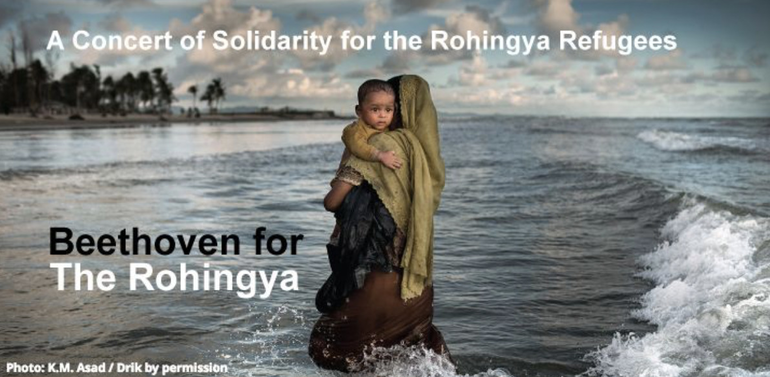
Music for Life International Present Beethoven For The Rohingya

Source tapinto, 6 Jan

Screen Shot 2019-01-06 at 9.18.33 PM.png
SHORT HILLS, NJ - Music for Life International will present Beethoven For The Rohingya, a humanitarian concert of Beethoven's monumental Ninth Symphony at 8 PM Monday, January 28, 2019 in Stern Auditorium/Perelman Stage at Carnegie Hall in New York City. The concert will also include the moving and deeply poignant Elegy for Violin and Orchestra by American icon David Amram with Elmira Darvarova, distinguished former Concertmaster of the MET Orchestra, as soloist with the composer conducting.  

The concert will focus on the plight of the Rohingya refugees displaced by the genocide and ethnic cleanising in Myanmar. We envision an historic musical event in this great concert hall and satellite events elsewhere that will refocus the world's attention on the situation of the Rohingya refugees and their families. The concert will serve as an urgent call to the global community to move as swiftly as possible to provide resources and support for the hundreds of thousands of men, women and children who have been forced to flee from their homes in Myanmar. Their testimony is devastating as it is wrenching. 

The military attacked us on Wednesday [30 August], they were more than 150 men strong. Before that, the village chairman told us to gather at the sandy banks of the canal in the village. We all gathered there; they were carrying weapons so we couldn't do anything else. Then they started killing the men in front of us. They placed the dead bodies on a dyke and burnt them.Then the military took groups of women inside the houses and stabbed us with machetes. One stabbed me near my vagina. Another stabbed my throat. I was holding my 28-day-old baby on my lap. They hit my baby with something heavy. It hit his head and he died. I saw how his skull split open and his brain came out. I'm glad that I made it here but I don't know where I will go after I'm discharged. I have nothing here, just the clothes on my back. I don't know anyone and my baby is dead. " - 25-year-old woman admitted to MSF medical facility for stab wounds to her throat and waist.

Sign Up for E-News

"There were 22 members in my family. Of them, 19 have been murdered, including small children. There are only three of us surviving - two brothers and one sister." - Brother of 18-year-old patient admitted to MSF's IDP in Kutupalong with stab wounds and burns.

Join us for this historic musical event at Carnegie Hall to refocus the world's attention on the situation of the Rohingya refugees and their families who have been forced to flee from their homes in Myanmar by a 21st Century genocide. We have said "Never Again" to ethnic and religious persecution too easily. Please come to Carnegie Hall on January 28th and make your voice heard through great music.

Tuesday, 8 January 2019

'Myanmar wants to drive out all Muslims': Q&A with Kyaw Hla Aung

Source Aljazeera, 27 Dec 2018

Leading lawyer speaks to Al Jazeera on plans for repatriation of Rohingya refugees and anti-Muslim sentiment in Myanmar.


'After driving all the Rohingya out they will go after all Muslims from across Burma' Kyaw Hla Aung [courtesy of Kyaw Hla Aung]

MORE ON ASIA

Doha, Qatar - U Kyaw Hla Aung is a well-known lawyer and activist who has been fighting for the rights of the Rohingya ethnic group in Myanmar for decades.

The 78-year Rohingya man was awarded this year's Aurora Prize by the Armenia-based Aurora Humanitarian Initiative for his advocacy of rights for the persecuted mostly Muslim minority.

He donated the $1m he received in prize money to humanitarian organisations providing medical aid and assistance to Rohingya refugees.

Nearly a million Rohingya were forced to take shelter in neighbouring Bangladesh after Myanmar's army, responding to attacks by an armed group, launched a brutal campaign against the minority in the country's western Rakhine state last year. 

The Rohingya have faced persecution in Myanmar for decades. The military government, which took power following a coup in 1962, stripped the Rohingya of citizenship in 1982.

Since 2012, following deadly riots between Rakhine Buddhists and Rohingya, tens of thousands of people from the minority have been forced to live in squalid internment camps.

Hla Aung, who was born in the city of Sittwe in Rakhine state, spent more than 12 years in jail for his political work on behalf of the Rohingya people. 

Al Jazeera caught up with the veteran activist in November in the Qatari capital, Doha, where he was invited to attend a global health conference.

Al Jazeera: Why have Rohingya been denied citizenship in Myanmar? What are the criteria for citizenship?

Hla Aung: According to the 1948 citizenship law, a person who lived in Myanmar for 10 years and eight years continuously was eligible for citizenship. They are denying us citizenship since 1982. 

A person who shows he owns land, should be accepted as citizen. But that's not happening.

In 1964, Myanmar's ruler General Ne Win nationalised all the shops, farms and companies owned by Indians, Pakistanis and the Chinese. He drove all the foreigners from Myanmar. At that time they didn't drive out the Rohingya people.

Rohingya belong to this land, they were recognised by the previous democratic governments, including under Prime Minister U Nu. But after the military coup [of 1982], they said Muslims were not a people of Myanmar.

My father owned land and I have documents but they [government] do not recognise it. In 1959, the government issued National Registration Cards to all the people, including Muslims. I also got my National Registration Card.

After driving all the Rohingya out they will go after all Muslims from across Burma [Myanmar]. They have a plan to drive out all the Muslims from this land.

Al JazeeraWhat do you think about the planned repatriation of Rohingya? 

Hla Aung: I do not trust Myanmar officials on the repatriation issue because they have not taken action against people who looted Rohingya property and cattle. So how can these people go back? Also, there is no protection [for the returnees] by law or by the government.

Al Jazeera: Can you tell us about the situation on the ground for the Rohingya in Myanmar?

Hla Aung: The government is biased against Muslims. Earlier, Rohingya people were represented in government departments such as the police, military, administration, education etc.

But this has changed over the years.

Successive governments have gradually denied Muslims jobs. I worked for a government company for over 20 years. I was jailed for writing a petition to General Ne Win against forced confiscation of lands belonging to Muslims in 1986.

Al JazeeraYou have lived in Rakhine state for more than 70 years. How were relations between Muslims and Buddhists when you were young?

Hla Aung: Before 1960, we lived together, we had very good relations. We could apply for jobs and that's how I was appointed as a stenographer. I got a promotion and faced little discrimination because of being a Muslim. Now, even judges discriminate between Muslims and Buddhists.

Al Jazeera: Why do you think there is so much anti-Muslim sentiment in Myanmar?

Hla Aung: They say that they are afraid of Muslims because they believe Muslims are spreading in the country.

The anti-Rohingya campaign has high-level political backing. But very few people are friendly. Buddhist people hate Muslims. The majority are against Muslims, only a tiny minority want to live together.

Al Jazeera: What are the issues facing the Rohingya community?

Hla Aung: Our people are not well educated. I want to give them education so they can know about their rights. I organise our people to be educated so that they will have courage to fight for their rights. In my opinion, education is the first priority for me.

Due to the lack of health facilities 500 to 1,000 will die but without education, the whole community will die within 10 years. 

OPINION

The Rohingya's dark anniversary must spur global action

Tun Khin
by Tun Khin

Al Jazeera: Tell us about the education initiatives you have undertaken in Rakhine state?

Hla Aung: We have opened schools and appointed nearly 121 teachers since 2012. We are reaching more than 10,000 students in villages.

Rakhine teachers do not come to Muslim villages. We collect some donations from our people to run the schools. I also approached Nobel laureate Shirin Abadi to help get funds.

I was arrested for my education initiatives. President Thein Sein granted me a pardon after one and a half years in prison. I was released on October 7, 2014.

Al Jazeera: Tell us about the democratic transition project pushed by Thein Sein?

Hla Aung: Thein Sein started the process of driving out Muslims from their land. He is the man behind the anti-Muslim policies.

Al Jazeera: You contested elections in 1990. Why didn't you win?

Hla Aung: I could have won but they didn't allow me. I was a candidate in 1990 parliamentary election. I was the vice president for National Democratic for Human Rights party.

Before the election, the western commander arrested me. I was imprisoned by a court-martial.

Al Jazeera: Tell us about your family.

Hla Aung: My parents were from Mrauk U but I was born in Sittwe during World War II. We fled from one village to the other as the fighting raged. At that time my father was head clerk of the state court. Our house was destroyed by the Japanese army.

In 2012, my house was destroyed by Rakhine terrorists. I have not been able to go back to my own house since then.

I worked for MSF for 14 years until 2012. MSF was kicked out by Rakhine terrorists and the government because the medical charity did not discriminate between Rakhine, Hindu and Muslims. 

Al Jazeera: You spent more than a decade in jail. Why?

Hla Aung: I was in jail from 1986 to 1988, another eight years between 1989 and 1997. I was imprisoned for two months in June 2012. My last stint in jail was from July 2013 to October 2014.

The first one was for writing a petition in support of Rohingya farmers. Then I was accused of organising people to set fire to houses. In the 2013 case, I was blamed for stone-throwing incident against government officials.

Al Jazeera: Do you think Myanmar will accept the Rohingya?

Hla Aung: They will never accept us. They deny our existence, they consider us as illegal immigrants.

Al Jazeera: What is the future of the Rohingya people? What are your hopes from the international community?

Hla Aung: The future is dependent on the international community, including the UN. We have to organise the international community to back the Rohingya cause at the UN.

When I went to Armenia to receive the Aurora award, their government assured me that they will help us. I asked them to stand behind Rohingya at the UN.

Al Jazeera: Are the Rohingya facing genocide? 

Hla Aung: It is indeed genocide because government does not accept the word Rohingya.

The government is not allowing the investigations of cases from the scene of the crimes. The International Fact-Finding Mission on Myanmar formed by the UN has not been allowed to enter Myanmar.