Tuesday, 24 September 2019

Rohingya crisis: Villages destroyed for government facilities

Source BBC, 10 Sept


Media captionJonathan Head visits the Hla Poe Kaung transit camp, which is built on the site of two demolished Rohingya villages

Entire Muslim Rohingya villages in Myanmar have been demolished and replaced by police barracks, government buildings and refugee relocation camps, the BBC has found.

On a government tour, the BBC saw four locations where secure facilities have been built on what satellite images show were once Rohingya settlements.

Officials denied building on top of the villages in Rakhine state.

In 2017 more than 700,000 Rohingya fled Myanmar during a military operation.

The UN has described it as "textbook ethnic cleansing". Myanmar (also called Burma) has denied large-scale killings by its forces.

Myanmar, a majority Buddhist country, continues to deny its troops carried out ethnic cleansing and genocide. It now says it is ready to take some refugees back.

But last month, a second attempt to start repatriating Rohingya refugees failed, after none of the 3,450 people approved by Myanmar to return agreed to do so. They cited the lack of accountability for atrocities committed in 2017, and uncertainty over whether they would get freedom of movement or citizenship.

Myanmar blamed Bangladesh, and said it was prepared to receive large numbers of returnees. To demonstrate this they invited journalists, including the BBC, to see their facilities.

Access to Rakhine is normally tightly restricted. We travelled in a government convoy, and were not allowed to film or interview people without police supervision.

But we were able to see clear evidence of the deliberate eradication of Rohingya communities.

The Australian Strategic Policy Institute, which has been analysing satellite images, estimates that at least 40% of Rohingya villages damaged by the 2017 violence have since been completely demolished.

What did the BBC find in Myanmar?

The government took us to Hla Poe Kaung transit camp, which it says can house 25,000 returnees, who would stay for two months before moving to permanent housing.

The camp, which was completed nearly a year ago, is in poor condition; the communal toilets have fallen apart. It was built on the site of two Rohingya villages, Haw Ri Tu Lar and Thar Zay Kone, demolished after the 2017 violence.

When I asked the camp administrator Soe Shwe Aung why they had destroyed the villages, he denied any had been demolished. But when I pointed out that satellite images showed otherwise, he said he had only recently taken the job and was not able to answer.

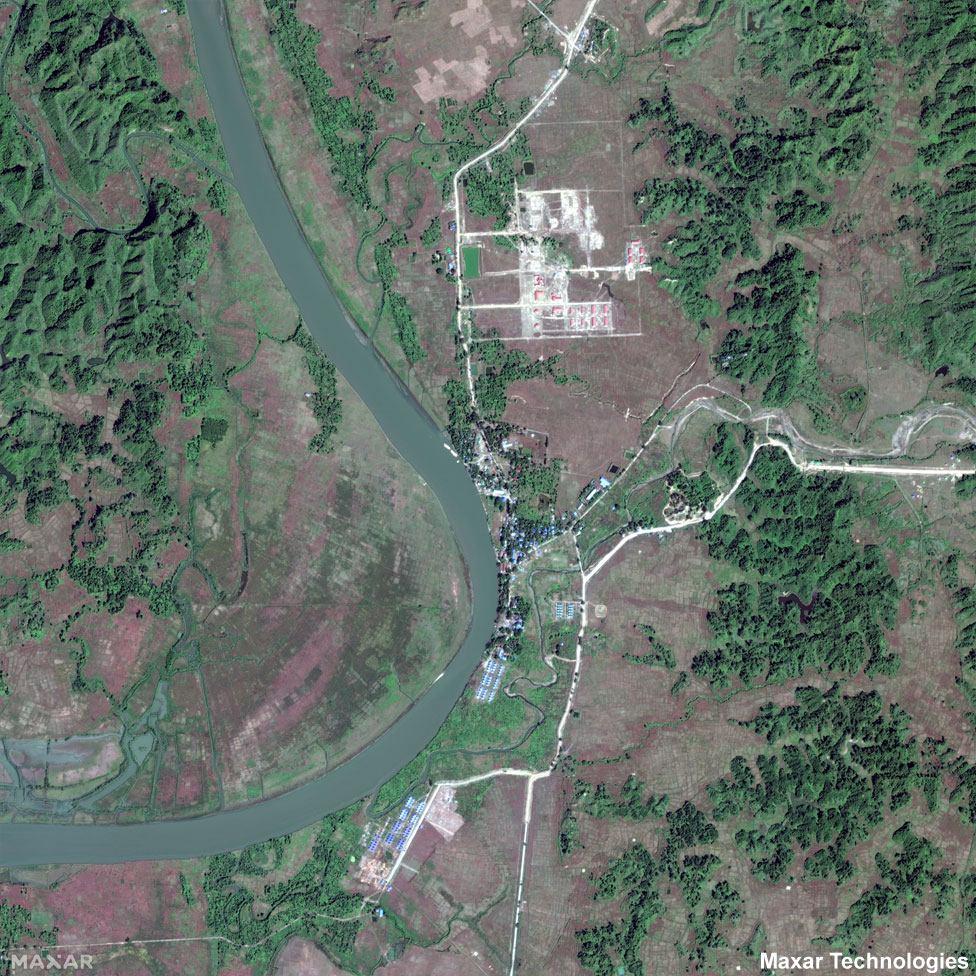
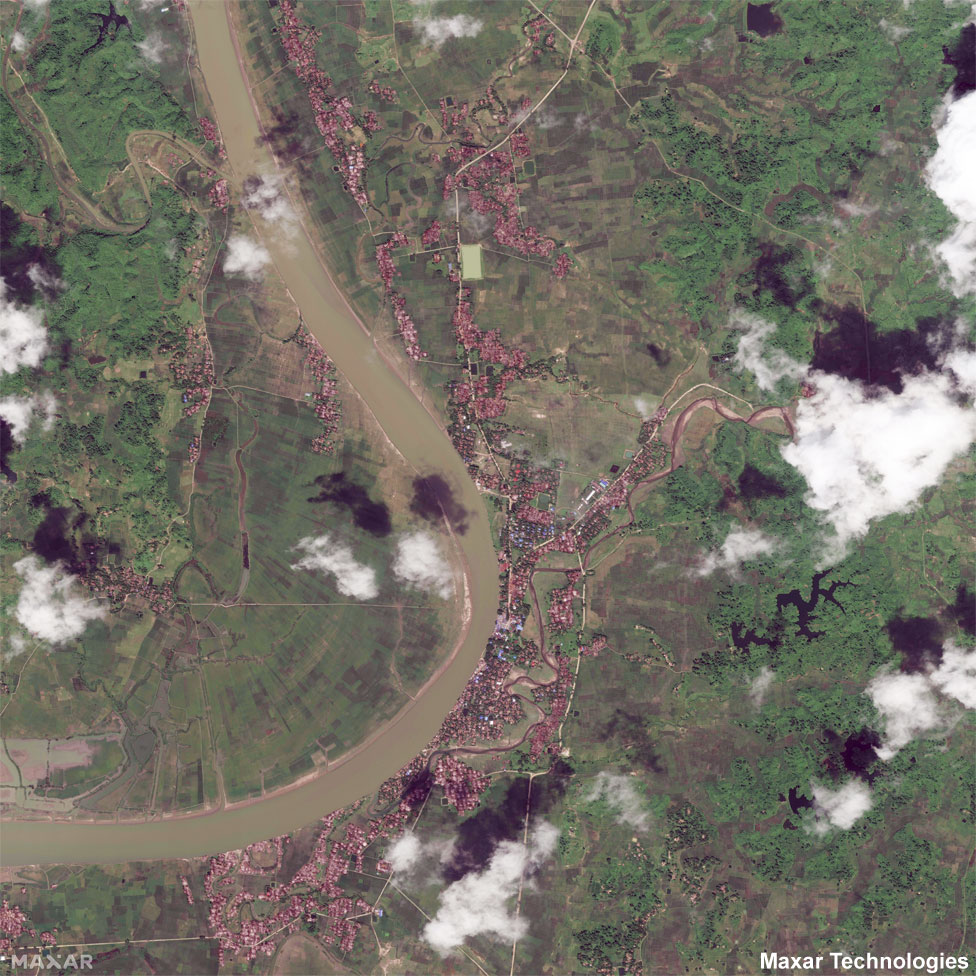
We were then taken to Kyein Chaung, a relocation camp, where houses have been built with Japanese and Indian government funding as long-term accommodation for returning refugees. But a Rohingya village called Myar Zin was bulldozed to clear land for this camp, which lies close to a massive new barracks for the Border Guard Police - a unit of the security forces accused by Rohingyas of serious abuses in 2017. Speaking off-camera, officials there confirmed the demolition of Myar Zin.

INTERACTIVEIf returning refugees can't go back to their original homes, they may be settled in "relocation sites" like Kyein Chaung. It, too, is built on the site of a Rohinya village.

23 December 2018

Kyein Chaung relocation camp

16 September 2017

Kyein Chaung relocation camp
Presentational white space

Just outside the main town, Maungdaw, was Myo Thu Gyi, which once had a population of more than 8,000 Rohingyas.

In September 2017, I filmed Myo Thu Gyi while driving past it in another government convoy. Many of the houses had been burned, but larger buildings were still intact, and the trees that usually surround Rakhine villages were still there. But now, passing where Myo Thu Gyi used to be, there is a large government and police complex. The trees have gone.

We were also taken to Inn Din, a village notorious for a massacre of 10 captured Muslim men in September 2017, and one of the few atrocities the Myanmar military has admitted to.

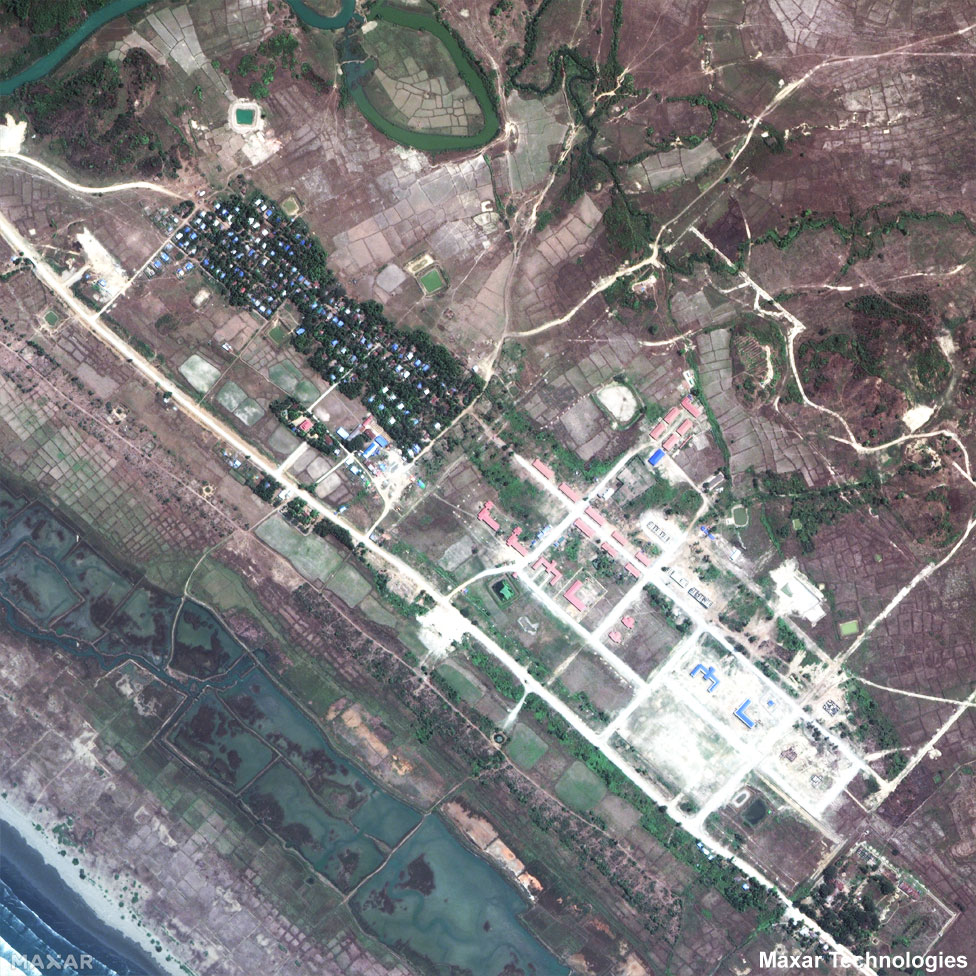
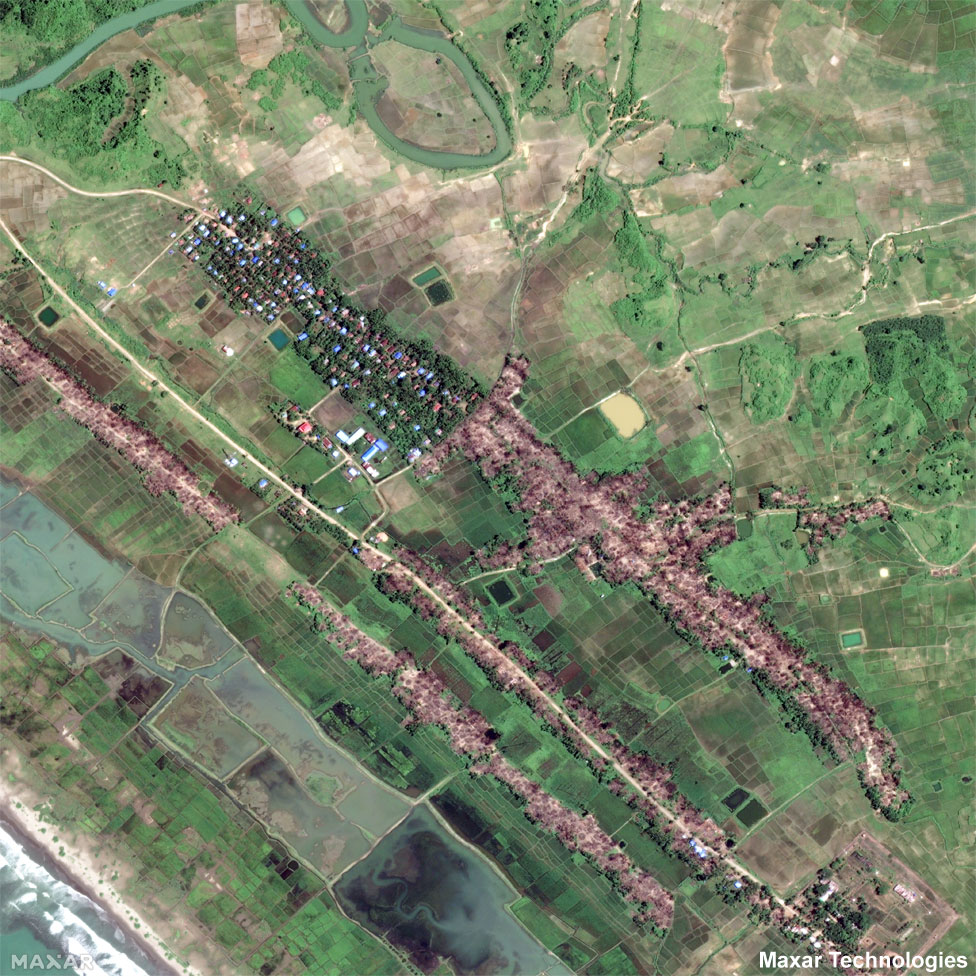
INTERACTIVESlide to see how much of Inn Din was destroyed except for the Rakhine Buddhist quarter. New police barracks has been built on the Muslim quarter.

19 April 2019

Inn Din camp

22 September 2017

Inn Din camp
Presentational white space

About three quarters of the population of Inn Din was Muslim, the rest Rakhine Buddhist. Today, no trace of the Muslim quarter remains. The Rakhine quarter is quiet and peaceful. But when you reach where the Rohingya houses used to be, the trees have gone, replaced by barbed-wire fences enclosing an extensive new Border Guard Police barracks.

The Rakhine Buddhist residents told us they would never accept Muslims living next to them again.

What does this mean for the refugees?

The extensive and continuing destruction of Rohingya communities long after the violent military campaign of 2017 had ended means few of the refugees would be able to go back to their old lives and communities.
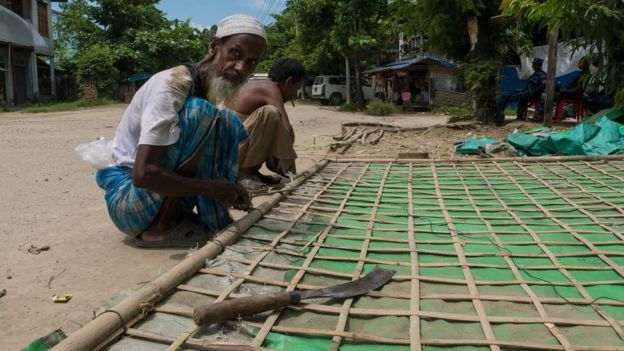
Maung Daw - Muslim manImage captionAs little as 10% of the original Rohingya population of Rakhine is believed to remain after the 2017 exodus

The only visible preparations for a large-scale refugee return are dilapidated transit camps like Hla Poe Kaung, and relocation camps like Kyein Chaung. Few refugees are likely to overcome the trauma they suffered two years ago for that kind of a future. It raises questions over the sincerity of Myanmar's public commitment to take them back.

I was able to meet a young displaced Rohingya on my way back to Yangon. We had to be discreet; foreigners are not allowed to meet Rohingyas without permission. He has been trapped with his family in an IDP camp for seven years, after being driven out of his home in Sittwe, one of 130,000 Rohingyas displaced in a previous outbreak of violence in 2012.

He is unable to attend university, or to travel outside the camp without permission. His advice for the refugees in Bangladesh was not to risk coming back, and finding themselves similarly confined to guarded camps.

What does the government say?

We approached the Myanmar government's spokesman for a response to our findings in Rakhine, but have not received a reply.
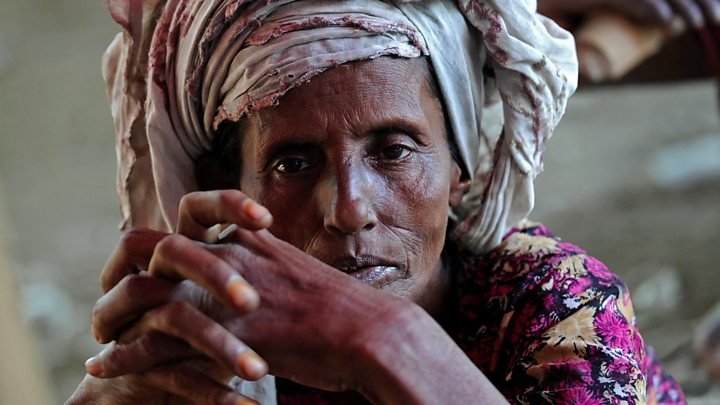
Media captionMyanmar: Who are the Rohingya?

Officially, the government is committed to a phased return of the refugees, in collaboration with Bangladesh. But ministers still refer to the Rohingyas as Bengalis, who they say arrived in waves of illegal immigration over the past 70 years. There is little evidence of such immigration.

This reflects a widespread belief in Myanmar that they do not belong. The government has refused Rohingya requests for citizenship and guaranteed freedom of movement. It is willing to give them what are called National Verification Cards, which it says could be a step towards eventual citizenship. But most Rohingyas reject these cards because they would be required to identify themselves as Bengalis.

At the height of the military campaign against the Rohingyas in early September 2017, the commander of the Myanmar armed forces General Min Aung Hlaing said they were taking care of what he called "unfinished business" left from 1942.
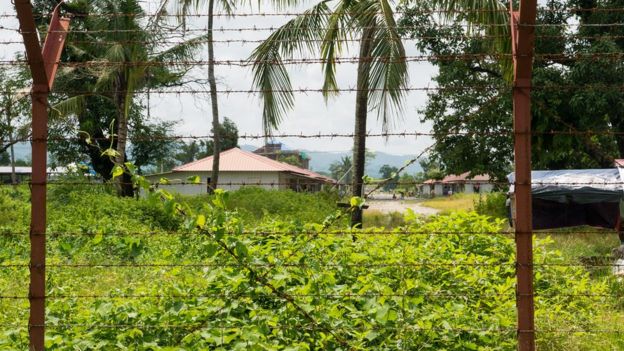
Inn DinnImage captionToday no trace of the Muslim quarter remains at Inn Din village, the site of one of the few atrocities the Myanmar military has admitted to

He was referring to the fighting then between Japanese and British forces in Rakhine, in which Rohingyas and Rakhine Buddhists backed opposing sides, often killed each other, and caused large-scale movements of displaced civilians. The commander said Muslims had flooded into northern Rakhine state over what is today the border with Bangladesh.

The two districts of Maungdaw and Buthidaung on the border, where the great majority of villages destroyed since 2017 were located, was the only region of Myanmar with a Muslim majority. Since the Rohingya exodus the remaining Muslims, perhaps only 10% of the original population, may now be in a minority.

The government's refusal to allow a credible investigation, to offer freedom of movement or a clear path to citizenship, will deter most refugees from returning. That would leave the balance between Muslims and non-Muslims as it is; perhaps the "unfinished business" is now finished.

Tuesday, 17 September 2019

600,000 Rohingya still in Myanmar at 'serious risk of genocide': UN

Source FrontierMyanmar, 16 Sept

A Myanmar border guard policeman stands near a Rohingya Muslim family in front of their home in Buthidaung Township, northern Rakhine State in January. (AFP)

By AFP

YANGON — Rohingya Muslims remaining in Myanmar still face a "serious risk of genocide", UN investigators said Monday, warning the repatriation of a million already driven from the country by the army remains "impossible".

The fact-finding mission to Myanmar, set up by the Human Rights Council, last year branded the army operations in 2017 as "genocide" and called for the prosecution of top generals, including army chief Senior General Min Aung Hlaing.

Some 740,000 Rohingya fled burning villages, bringing accounts of murder, rape and torture over the border to sprawling refugee camps in Bangladesh, where survivors of previous waves of persecution already languish.

But in a damning report, the United Nations team said the 600,000 Rohingya still inside Myanmar's Rakhine state remain in deteriorating and "deplorable" conditions.

"Myanmar continues to harbour genocidal intent and the Rohingya remain under serious risk of genocide," the investigators said in their final report on Myanmar, due to be presented Tuesday in Geneva.

The country is "denying wrongdoing, destroying evidence, refusing to conduct effective investigations and clearing, razing, confiscating and building on land from which it displaced Rohingya", it said.

Rohingya were living in "inhumane" conditions, the report continued, adding over 40,000 structures had been destroyed in the crackdown.

'War crimes'

The mission reiterated calls for the UN Security Council to refer Myanmar to the International Criminal Court (ICC) or to set up a tribunal, like for the former Yugoslavia and Rwanda.

It said it had a confidential list of over 100 names, including officials, suspected of being involved in genocide, crimes against humanity and war crimes, in addition to the six generals named publicly last year.

The report also repeated calls for foreign governments and companies to sever all business ties with the military, calling for a "moratorium" on investment and development assistance in Rakhine state.

The maligned Muslim community has long been subjected to tight movement restrictions, making it difficult or impossible for many to access healthcare, work and education.

The Rohingya are denied citizenship in Buddhist-majority Myanmar and are accused of being illegal immigrants from neighbouring Bangladesh.

The army justified the crackdown as a means of rooting out Rohingya insurgents.

Bangladesh and Myanmar signed a repatriation deal two years ago, but virtually no refugees have returned to date.

The investigators described conditions in Myanmar as "unsafe, unsustainable and impossible" for returns to take place.

They also accused the army of fresh abuses against civilians in the north of Rakhine state.

The area has once again become embroiled in conflict as the military wages war on the Arakan Army (AA), rebels fighting for the rights of ethnic Rakhine Buddhists.

The UN probe accused the military of "war crimes", including forced labour and torture and said the AA was also guilty of abuses on a smaller scale.

Myanmar military spokesman Brigadier General Zaw Min Tun rejected the team's findings, calling them "one-sided".

"Instead of making biased accusations, they should go onto the ground to see the reality," Zaw Min Tun told AFP.

Tags: 

Nicholas Koumjian (IIMM) - 1st Meeting, 42nd Regular Session Human Rights Council

Source UNweb, 9 Sept

Nicholas Koumjian (IIMM) - 1st Meeting, 42nd Regular Session Human Rights Council

9 Sep 2019 - Presentation of report by Nicholas Koumjian, Head of International Investigative Mechanism for Myanmar


Available languages:
Nicholas Koumjian (IIMM) - 1st Meeting, 42nd Regular Session Human Rights Council 

“The ‘Enemy of the State’ Speaks–Irreverent Essays and Interviews:” Maung Zarni on Burma/Myanmar

Source Transcend, 9 Sept

"The Enemy of the State" Speaks: Irreverent Essays and Interviews, by Maung Zarni, Gerakbudaya: 2019

"Maung Zarni speaks truth to power and his words are powerful because they come from his own lived and personal experience."

— Mairead Maguire – Nobel Peace Laureate, Peace Activist and Member of the TRANSCEND Network for Peace Development Environment

"While the world's academics and politicians were focused on the hopes for change conjured up by the charisma and fame of Aung San Suu Kyi, Zarni presciently warned of signs of more fundamental problems with the promised "transition" agenda for Myanmar. Zarni's various writings and interviews represent an unending attack on the misrepresentations of the Myanmar political, military, commercial, and monastic establishment and the misunderstandings of foreign actors who were beguiled by the promises of natural resources, trade wealth, and political change. Now, as the Myanmar Tatmadaw and the Lady have revealed their true colors, the international community has found that Zarni has had something very important to say that should have been heeded. I strongly recommend this collection of insights into a country that most scholars of the country and nearly all politicians have consistently gotten wrong over the course of the past few decades."

— Prof. Michael W. Charney – Chair of Southeast Asian and Military History SOAS, University of London

*********************

********************

Introduction by Maung Zarni

It is often said that a week in politics is a long time.  Through this collection of essays, published at integral moments in Myanmar's monumental political events, I look back over the last decade of Myanmar's national affairs.

Over the years, I have written hundreds of blogs, commentaries, a small collection of academic essays, and given numerous media interviews, which capture my thinking at the time of important developments in Myanmar's recent history.  This collection contains short essays written for "the general public", and a number of interviews I gave to different national outlets.  They have been published by various media outlets including the New York Times, Guardian, Bangkok Post, New Statesman, Democratic Voice of Burma, Arab News, TRANSCEND Media Service, and Prothom Alo.

The wild and unpredictable swings in Burmese affairs have been both shocking and mesmerizing:  in 2007 Myanmar monks captured the world's attention with their public recital of Metta Sutra (Loving Kindness Prayers) as an act of non-violent resistance to the ruling military junta headed by the then sitting despot, Senior General Than Shwe.  My own late great-uncle Zeya Kyaw Htin Lt-Colonel Ant Kywe (recipient of 1st Class National Chronicle award for his role in Burma's liberation struggles against the British rule and the Japanese occupation) was Than Shwe's first-ever Commanding Officer who performed the young Captain Than Shwe's marriage ceremony.  Having donned the saffron robe twice, first as a young novice customarily in Mandalay, second, as a grown-up male, voluntarily in Northern California, I remember penning a commissioned essay for the Times (in London), with heart-felt joyous reaction to the fact that the country's most influential cultural institution was exercising its form of power in order to bring about the urgently needed changes in politics, having called on the authorities to alleviate the collective sufferings of the predominantly Buddhist public.

I also remember having felt so proud to be seated next to Myanmar State Counsellor Daw Aung San Suu Kyi, then the leader of the opposition National League for Democracy, when she appeared as the guest of honour at the televised Rule of Law Roundtable at the London School of Economics, on 18 June 2012.  As it turned out to be her 67th birthday our Roundtable ended by singing Happy Birthday to "Daw Suu", before she proceeded to the Green Room inside the auditorium to cut her birthday cake.

Despite her human flaws – who doesn't have them, anyway? –  Daw Suu was my inspiration whose tales of courage and sacrifice pushed me over the line: I organized and led international consumer boycott and other grassroots activist campaigns against the Burmese military while studying in the United States.   I was her staunch supporter for 15 years – from the day she delivered her maiden speech in Yangon in July 1988 in the midst of political uprisings in Burma – till 2004 when I became convinced that her advocacy for isolation of Burma was no longer advancing the democratic change we so needed in Burma.

Besides having been fellow dissidents, her martyred father has been my life-long idol, an honest revolutionary and a public intellectual who had the personal strength and integrity to admit mistakes and correct them. Unlike Suu Kyi, Aung San the father was the very first Burmese leader who envisaged a new, independent Burma as a secular, multiculturalist country of many nations and faiths.  To the late Aung San Burmese was to be defined non-biologically – colour-, race-, faith- and creed-blind.  Anyone who loved the country as their birthplace and worked towards the common good of all was to be embraced as 'citizens'.

In fact, I was raised inter alia on the first-hand inspiring oral sketches of her late father as recounted by my other great-uncle Wunna Kyaw Htin U Zan Yin, who was Aung San's next-door neighbour, undergraduate classmate and friend at Pegu Hall in Rangoon University in the 1930's during the years when anti-imperialist Marxist-inspired nationalism was sweeping across the ideological landscape of colonial Burma, particularly among a small band of Burmese students from bourgeoise native families among the colonized elites.

So, when both the Burmese monastic order in general and Aung San's daughter turned "evil", that is, one institution becoming the cultural platform for disseminating a potent strain of Islamophobia in general and the genocidal anti-Rohingya hatred in particular, I was extremely distraught, devastated, and utterly disillusioned about the diminishing prospects of my country's transition from the military-ruled or -controlled rotten political system to something ideologically more progressive, politically more democratic and multicultural.

In fact, my disillusionment with the majoritarian Burmese politics had already set in even before Myanmar hit world news headlines with the organized violence against Muslim Rohingyas in Rakhine State six years ago.

When the world went hysterical about the "reforms" by Myanmar military, I was the lone voice in the loud chorus of wild celebrations and welcome discourses.  From the margins of both Burmese and world affairs, my essays and interviews cautioned pointedly against the euphoria of "Myanmar Spring", which was "rewarded" with the official visit to Yangon by Barack Obama in November 2012, the first-ever visit of a sitting American President in history.  I remember writing an essay for the Bangkok Post with the title "what US President Barack Obama should tell President Thein Sein".   Aung San Suu Kyi's colonial-era village at 54 University Avenue in Yangon fast-morphed into a place of political pilgrimage: the ever-growing number of heads of state, Hollywood icons, "star academics", renowned journalists, sort sipping tea with the English-influenced Asian Mandela and holding joint press conferences.

Burma was to be "a model transition", which Washington openly urged N. Korea and Iran, America's favourite "rogue states", to emulate.  Burma was to be the showcase of Obama's legacy of "extending a hand" to America's adversaries.   What a gratifyingly Hollywood-like ending of the Burmese liberation struggle that was!, or so the headlines of the day would have you believe.  I remember questioning the Hollywood ending in my own hard-nose empirical analyses in those days.

The dizzying speed  of developments in the country's affairs did make it feel as if Burma of 2010 onwards was the tale of the triumph of the good over the evil: the Oxford-educated Asiatic beauty with jasmines on her hair who speaks impeccable Queen's English, whose struggle the Western Bloc had backed over 25 years, beating the beastly generals with their halting or broken Ngapi (or fish-paste) accented English.

Against this tide of euphoria and policy hysteria I kept on writing essays sprinkled with my unconcealed pains – and uncompromising empiricism –  about what I knew to be 'extraordinary delusions' about my country's affairs, the ruling military, and the "general's daughter" or "The Lady", that is, Aung San Suu Kyi herself.

You see I came from a large extended family whose three-generations of members, both men and women, have served in the Burmese Armed Forces since the institution's foundation in 1942.  Although I am known as a human rights activist, my academic specialization really is the military affairs, its neo-totalitarian ideology, opaque and secretive inner workings, and how it has devastatingly shaped the Burmese society at large in various crucial aspects – including education, intellectual life, social sphere, economy, ethnic relations and Sangha-society linkages.  As a matter of fact, and against the prevailing Burma policy orthodoxy of the West, I had even worked with the Burmese military officials including the then ex-intelligence chief, the now President ex-General Myint Swe and Joints Chief of Staff of the Armed Forces General Mya Tun Oo, with the view towards breaking the country's international isolation.

The essays and interviews in this collection contain my changing and developing views and analyses, not often expressed in politically correct tone or tactfully.    They are organized thematically, loosely speaking, Buddhism, Islamophobia and Violence, the Mirage of Reforms and Democratic Change, Understanding Myanmar Military, Ethnic Rebellions and Elusive Peace, Myanmar Genocide against the Rohingya, International Activism, a Way Forward, and Speaking Truthfully: Interviews with Zarni.

Readers will not fail to notice the skepticism that typically informs my essays.  I take pains not to commit an analyst's cardinal sin: I do not engage in strategic or policy positioning of myself in my Burma analyses.  I don't seek a seat at any policy table.   I write what I find, not what I think would advance my position within the Burma policy circles.

As a Burmese who had devoted more than half of his life – I am 56 – studying his birthplace and being intimately involved in trying to change its affairs for the better, I yearn to feel optimistic about my country, the future of my fellow people, including Rohingyas – whom we have discarded out of the government-manufactured hatred and fear as "proxies" for Islamists.  So, I have chosen to end the collection with a forward-looking essay, taking to heart the late Italian labour organizer Antonio Gramsci's dictum "pessimism of the intellect, optimism of the heart".  Even at times the heart can barely feel optimistic about one's own beloved country whose transition is turning out to be a genocidal one towards Fascism with a Buddhist veneer.   Still I want to remind my fellow Burmese, including those generals and NLD leaders that a nation's people, irrespective of their race or faith, are a state's assets, not its enemies.  Thus speaks Myanmar's so-called Enemy of the State.

___________________________________________

A Buddhist humanist from Burma, Maung Zarni is a member of the TRANSCEND Network for Peace Development Environmentformer Visiting Lecturer with Harvard Medical School, specializing in racism and violence in Burma and Sri Lanka, and Non-resident Scholar in Genocide Studies with Documentation Center – Cambodia. Zarni is coordinator for Strategic Affairs for Free Rohingya Coalition and an adviser to the European Centre for the Study of Extremism, Cambridge, UK. His analyses have appeared in leading newspapers including the New York Times, The Guardian and the Times. Among his academic publications on Rohingya genocide are The Slow-Burning Genocide of Myanmar's Rohingyas (Pacific Rim Law and Policy Journal), An Evolution of Rohingya Persecution in Myanmar: From Strategic Embrace to Genocide, (Middle East Institute, American University), and Myanmar's State-directed Persecution of Rohingyas and Other Muslims (Brown World Affairs Journal). He co-authored, with Natalie Brinham, Essays on Myanmar Genocide. Zarni holds a PhD (U Wisconsin at Madison) and a MA (U California), and has held various teaching, research and visiting fellowships at the universities in Asia, Europe and USA including Oxford, LSE, UCL Institute of Education) , National-Louis, Malaya, and Brunei. He is the recipient of the "Cultivation of Harmony" award from the Parliament of the World's Religions (2015).


Tags: 


This article originally appeared on Transcend Media Service (TMS) on 9 Sep 2019.

Anticopyright: Editorials and articles originated on TMS may be freely reprinted, disseminated, translated and used as background material, provided an acknowledgement and link to the source, TMS: "The 'Enemy of the State' Speaks–Irreverent Essays and Interviews:" Maung Zarni on Burma/Myanmar, is included. Thank you.

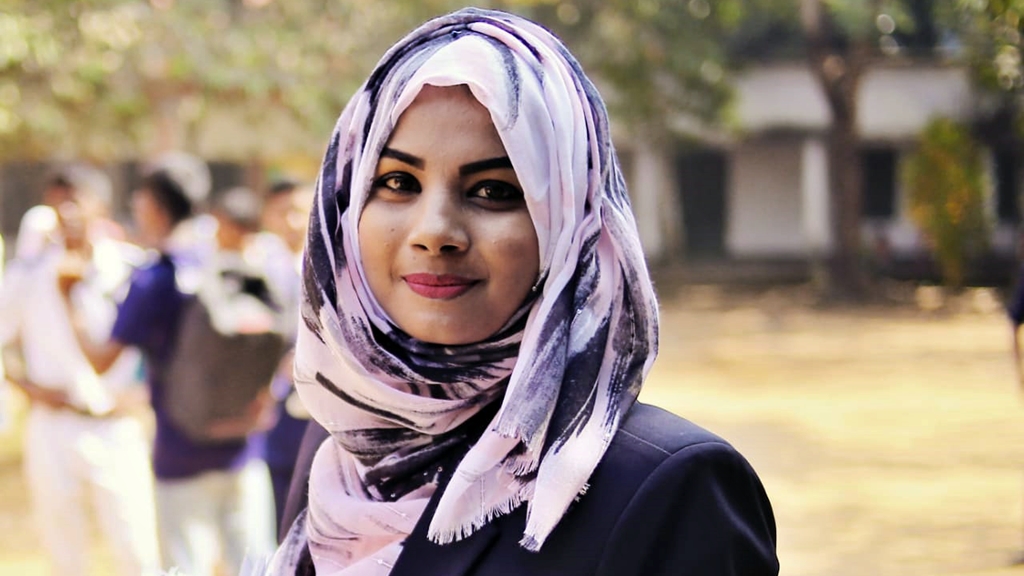
REFUGEE GIRL EXPELLED FROM UNIVERSITY FOR BEING ROHINGYA IN BANGLADESH

Source Rohingyapost, 7 Sept

"Khushi is an asset for both Bangladeshi and Rohingya communities. As a refugee, she has suffered so much, and yet she is persistent in following her dream. She has been contributing towards the host society a lot. And she also doesn't forget her ethnicity and persecutions. The denial of her university education is a great injustice. The government and the public should pave the path for education to refugees like her. She is a bridge for both communities. It seems the bridge being destroyed, along with her dream"

Rahima Akter Khushi is a 20-year-old Rohingya refugee girl born in Kutupalong Refugee Camp, Bangladesh after her parents fled Myanmar Military Junta's atrocities in 1992.

She is among 34,000 registered refugee who are protected under UNHCR and granted the legal refugee status unlike over 750,000 Rohingya fled into Bangladesh since August 2017.

She was brought up in the camp without formal education that is being provided to most Rohingya refugee children inside camps.

Since the government of Bangladesh prohibits Rohingya from receiving formal education inside and outside the camps, many Rohingya students hide their identity to enrol in private and public schools and colleges beyond the boundaries of camps.

Ms. Khushi has managed to complete her secondary and high schools with excellent results. She was accepted at Cox's Bazar International University (CBIU) to read her LLB at the Department of Law where she was in her second semester of the first year.

After her interview with AP News went public highlighting the dream being as Rohingya refugee girl, the Academic Council of CBIU has taken decision to immediately expel her from the university on September 6, 2019.

After the interview went viral which many people from all over the world praised her wisdom and dream to pursue education to empower herself and others, many right-wing Bangladeshi media outlets and activists have campaigned to disallow her from pursuing her dream, coupled with the government's stance on the prohibition of formal education for Rohingya refugees.

After the government has sent notice to many schools in Cox's Bazar district to "take strict measures so that no Rohingya children can attend any Bangladeshi educational institutions outside of the camps", six schools have expelled all Rohingya students in January and February, 2019.

Before and after the expulsion from CBIU university, Ms. Khushi has received threats including death-threats on social media in Bangladesh.

On July 4, 2019, she escaped from an attempted kidnapping resulting in injuries, for which she was treated at Fouad Al-Khateeb Hospital in Cox's Bazar.

She now went into hiding, and family relatives have reported that she is suffering from mental health issues threatening of taking her own life.

Despite being born in difficult situations in the camp, Ms. Khushi is an inspiring young girl with full potentials for both Bangladeshi and Rohingya communities.

She is involved in several social and educational campaigns and activities in the host community to empower Bangladeshi girls and women, educate children, equip with the community with IT skills, and strive for the rights of Rohingya refugees.

She also serves as executive member at Marquee Foundation, financial secretary at Prothom Alo Bndushova, Chief Executive Officer at Divas – a female empowerment organisation, director and founder of Women Learning Centre and the first female assistant computer trainer at Poura Preparatory ICT Computer Training Centre.

"Khushi is an asset for both Bangladeshi and Rohingya communities. As a refugee, she has suffered so much, and yet she is persistent in following her dream. She has been contributing towards the host society a lot. And she also doesn't forget her ethnicity and persecutions.

"The denial of her university education is a great injustice. The government and the public should pave the path for education to refugees like her. She is a bridge for both communities. It seems the bridge being destroyed, along with her dream," said a colleague of hers under the anonymity.

In October 14, 2018, Ms. Khushi told AP News, "There is no end in my dream. I have a lot of dreams."

For the moment, her dream is being shattered.

Friday, 6 September 2019

UN rights investigator on Myanmar lambasts Suu Kyi

Source TheDailyStar, 3 Sept

Myanmar forcing Rohingya to accept ‘foreigner’ label

Source Presstv, 3 Sept

In this file photo, taken on September 17, 2017, Rohingya refugees are seen protecting themselves from the rain in Bangladesh. (By AFP)In this file photo, taken on September 17, 2017, Rohingya refugees are seen protecting themselves from the rain in Bangladesh. (By AFP)

A human rights organization says Myanmarese authorities are forcing members of the persecuted Rohingya Muslim minority to accept identity cards that strip them of the chance to become citizens.

In a report published on Tuesday, Fortify Rights said that the National Verification Card (NVC) scheme targeting Rohingya Muslims was part of a systematic campaign by Myanmarese authorities to erase their identity.

The government has coerced Rohingya to accept the NVCs, "which effectively identify Rohingya as 'foreigners,'" the group said.

The report, titled "Tools of Genocide," also said Myanmarese authorities used torture and abuse to force Rohingya into accepting the verification cards.

"These findings demonstrate that the NVC process has not been a response to the crisis in Rakhine State, as the government suggests, but rather a fundamental part of the crisis," it added, referring to the state where the Rohingya had been concentrated before hundreds of thousands of them fled state-sponsored violence to neighboring Bangladesh.

The group also says "citizenship scrutiny" processes have progressively limited their rights, including freedom of movement, access to education, and freedom of expression.

Matthew Smith, the group's chief executive officer, also said, "The Myanmar government is trying to destroy the Rohingya people through an administrative process that effectively strips them of basic rights."

The United Nations Independent Fact-Finding Mission on Myanmar also found an increase in pressure on the Rohingya to accept the NVC in the months leading up to August 2017.

More than 730,000 Rohingya Muslims fled Rakhine to neighboring Bangladesh following a military-led crackdown in 2016 that the UN has said was perpetrated with "genocidal intent."

Thousands of Rohingya Muslims were killed, injured, arbitrarily arrested, or raped by Myanmarese soldiers and Buddhist mobs mainly between November 2016 and August 2017.

The latest development comes days after a second failed attempt to repatriate the refugees from Bangladesh.

Citizenship is at the heart of Rohingya demands for a return to Myanmar.

The Rohingya have inhabited Rakhine for centuries, but the state denies them citizenship. Bangladesh refuses to grant them citizenship, too.